Mirra Call Smart Mirror.
My Role
Primary Product Manager. I joined the project under the direction of the Product Advisor, who held final decision-making authority. My responsibility was end-to-end delivery management across a four-month challenge — from backlog and documentation through to live judging presentation.
The Problem
Stroke survivors and seniors completing upper-limb rehabilitation typically have limited access to therapy inside and outside clinical settings. Without consistent guidance and feedback, rehabilitation dosage drops — meaning fewer repetitions, slower recovery, and greater dependence on caregivers and clinicians. The Mirra Call smart mirror was designed to address this gap: it helps patients perform self-care tasks through guided visual and audio feedback, and offers empathetic voice interaction while they wait for human support. This in turn alleviates a health care worker burden that’s facing underfunding.
Outcome
Delivered all required checkpoint submissions on time across the four-month challenge period. Coordinated delivery across a multidisciplinary team whose active participation fluctuated from approximately 10 contributors to 3 core contributors over the course of the challenge. The final prototype combined working hardware and software components demonstrated at a live judging event. Our team placed silver based on our live presentation, prototype iteration documentation, product demo, video pitch, and trifold display.
Skills Demonstrated
Product requirements documentation · Backlog management · Cross-functional team coordination with fluctuating team size · Hardware + software delivery · Stakeholder communication · Risk management · Supported clinician validation · Owned the communication of product value through pitch and presentation development and delivery · Technical writing · Agile delivery
The Product.
The Mirra Call smart mirror is an AI-enabled rehabilitation system combining:
Computer vision (CV) tracking — monitors patient movement in real time
Augmented reality (AR) overlays — provides visual guidance during exercises
Voice-based AI guidance — delivers instructions and encouragement without requiring screen interaction
Embedded hardware (Jetson + depth camera) — enables home deployment without cloud dependency
Primary users: Stroke survivors with partial mobility loss; seniors aging in place Secondary users: Occupational therapists, physiotherapists, caregivers
Success metrics:
% increase in daily task completion
User engagement time per session
Adherence to prescribed routines
Reduction in caregiver intervention frequency
My Contributions.
Backlog & Timeline Management I built and maintained a skills-mapped product backlog, aligning task assignments to individual team strengths across hardware, software, and design workstreams. Coordinating across these three disciplines — where a change in the hardware setup could immediately affect the software integration — required constant prioritization and proactive communication to keep delivery on track.
Backlog management included mapping gaps to work to skills, tracking dependencies, reprioritizing based on changing constraints, managing fluctuating team capacity and keeping deadlines on track. I influenced prioritization and scope discussions based on delivery risk, available hardware, and milestone deadlines.
Product Documentation I authored the core documentation infrastructure for the project:
Product Requirements Document (PRD)
Prototype Iteration Logbook
Project Summary
Hardware/Software Reference Guide
For a cross-functional team building at the intersection of embedded hardware and AI software, clear documentation wasn't optional — it was what kept the team aligned, on track, and supported communications when technical complexity created ambiguity.
Stakeholder Communication I delivered weekly status updates to the Product Advisor covering completed deliverables, upcoming milestones, and risk mitigation strategies. Whenever the software workstream appeared stalled, I proactively stepped in to directly assign tasks and check in, prioritizing on-time checkpoint submission without compromising the other workstreams.
Pitch & Presentation I co-developed and wrote:
A 2-minute video pitch
A 6-minute judged presentation
A live judging display trifold synthesizing team learnings, prototype iterations, and future plans
Each required translating embedded hardware and computer vision concepts into language accessible to non-technical judges, and developing the narrative used to communicate the product's value proposition, technical approach, validation findings, skills that I'd argue are central to product management in any technical domain.
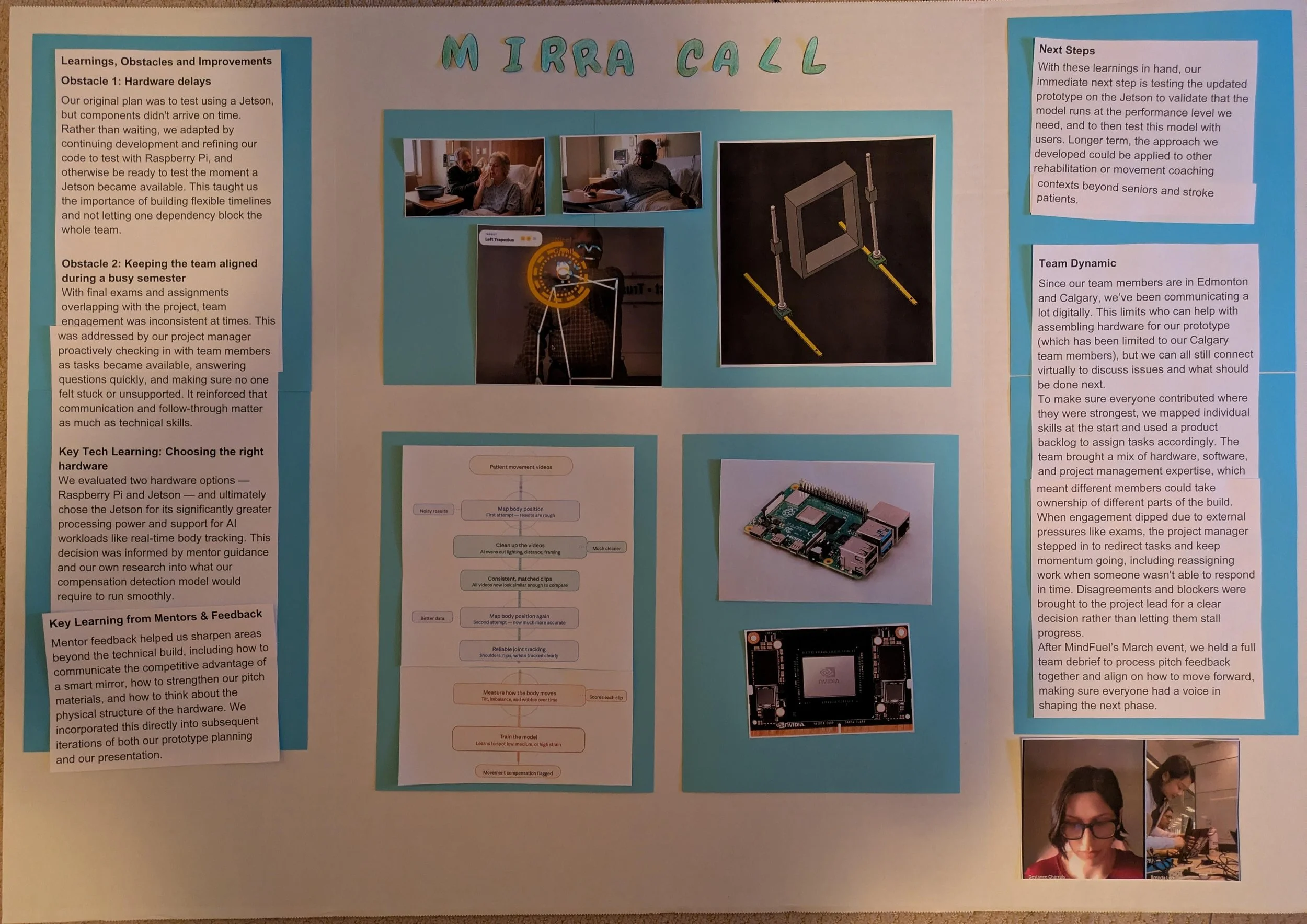
Trifold display in progress before taping everything in their current spots
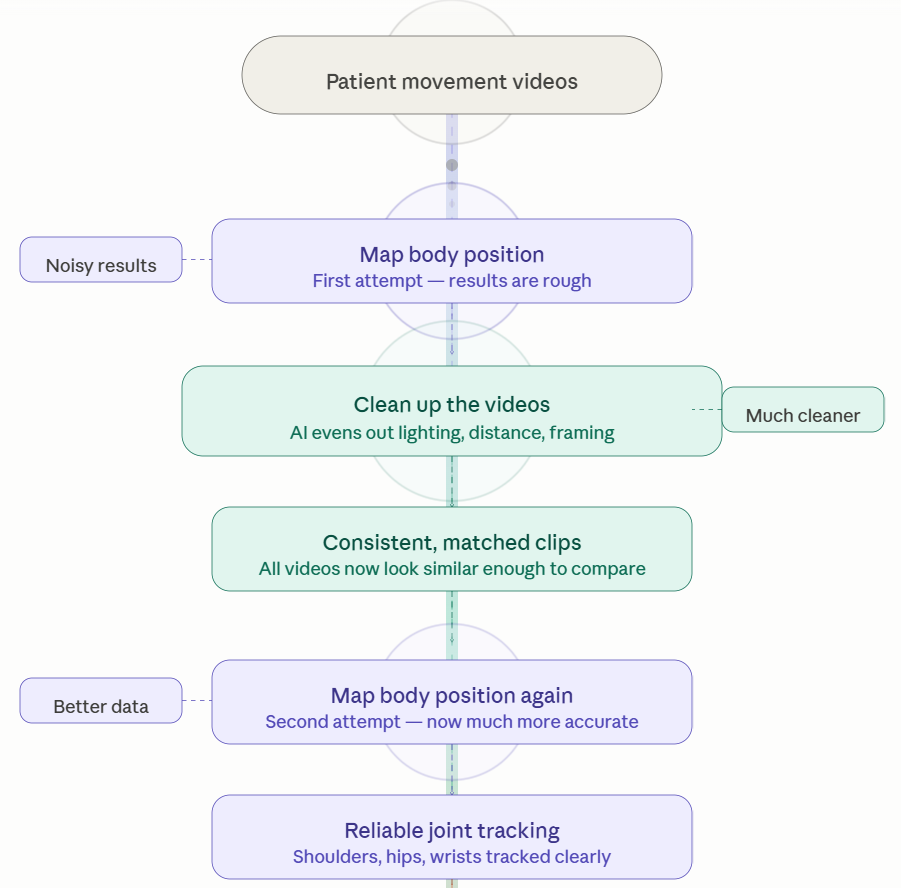
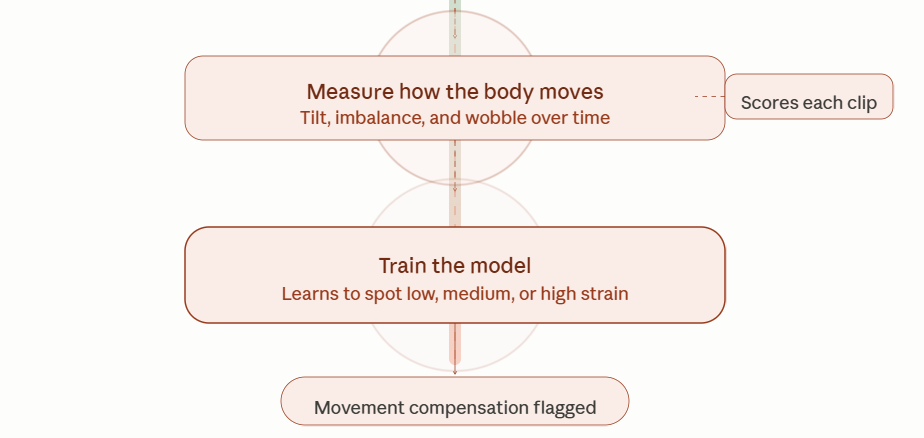
What I’d Do Differently.
As PM without final decision authority, there were moments where I needed to move faster on scope decisions than the approval process and engagement of team members allowed. In hindsight, I'd have established clearer decision rights with the Product Advisor at the start — defining which decisions I could make independently vs. which required sign-off — so that the team experienced less friction during the final phase when speed mattered most.